


3D micro-optics on optical fibers
Nanoscribe’s high-precision 3D printing enables the fabrication of freeform micro-optics directly on fiber end facets. Automatic alignment with ≤ 500 nm accuracy ensures precise positioning relative to the fiber core and its orientation. Together, these capabilities enable highly miniaturized fiber-optic systems for datacom, telecom, medical imaging, sensing and photonic packaging.
Advanced optical fiber functionalities enabled by micro-optics


High-resolution 3D printing of micro-optics on optical fibers
The fabrication of micro-optics directly on optical fibers enables system miniaturization and precise control of light at the fiber interface. This compact integration eliminates delicate assembly steps and avoids additional alignment, bonding or gluing, while allowing optical functionalization directly at the fiber tip.
Producing high-precision micro-optics on fibers requires submicron resolution, excellent surface quality, and accurate alignment to the optical axis. Nanoscribe’s Quantum X align addresses these challenges by fabricating freeform, multi-surface, and compound optical systems directly on fiber facets, leveraging automatic alignment with ≤ 500 nm detection accuracy. By combining refractive and diffractive functionalities within a single compact structure, 3D-printed micro-optics achieve optical performance beyond classical fabrication approaches.
Fiber-based 3D micro-optics
Nanoscribe’s Two-Photon Grayscale Lithography (2GL®) extends conventional Two-Photon Polymerization (2PP) with more than 4,000 gray levels. By tuning voxel dimensions during exposure, 2GL produces smooth, continuous refractive and diffractive optical elements with high shape fidelity — critical for transmission efficiency and beam quality. At the same time, 2GL reduces printing times compared to layer-based 2PP without compromising optical quality.
Quantum X align uses 3D printing by 2GL® to fabricate micro-optics directly on fiber facets, eliminating the need for further bonding or assembly effort while maintaining high design flexibility and throughput. This way highly miniaturized optical systems can be realized with functional surfaces directly at the fiber interface, for example in endoscopic imaging.
Misalignment of optical elements relative to the optical axis directly affects modal behavior, optical performance, and coupling efficiency. Nanoscribe’s Aligned Two-Photon Lithography (A2PL®) ensures precise positioning by detecting the fiber core and optical axis, followed by automatically aligned printing in a single process step.
The systems support a wide range of fiber types, including single-mode, multimode, and polarization-maintaining fibers as well as fiber arrays. This versatility allows the fabrication of highly integrated microoptical systems for applications such as beam shaping, optical trapping, imaging, structured light generation, optical sensing, and photonic coupling.
Why Quantum X align for 3D micro-optics on fibers
Key advantages of Quantum X align for micro-optics on fibers include:
-
3D printing by 2GL®: Fast 3D nano- and microfabrication with excellent optical quality, high shape accuracy, and short cycle times, featuring ultra-smooth finishes (Ra down to 5 nm), and high-resolution diffractive elements.
-
Broad fiber compatibility: Wide range of optical fiber types, including single-mode fibers (SMF), multimode fibers (MMF), polarization-maintaining (PM) fibers, and fiber arrays. Find more types here.
-
Broad material portfolio: Validated photoresins for optics manufacturing with high transparency from UV to NIR, a range of refractive indices and Abbe numbers, and proven stability under laser, thermal, and humidity stress.
-
High-throughput fiber processing: Up to 4 × 8 fibers processed in a single print run, supporting scalable manufacturing of micro-optics on fiber facets.
-
Automatic alignment: Printing with alignment to the fiber core and optical axis using high-accuracy optical detection, eliminating additional assembly steps.
-
Easy alignment workflows via intuitive GUI: Visual configuration of simple and complex alignment routines without scripting, accessible to all user levels.
-
Industry-proven technology: Nanoscribe’s aligned 3D printing solutions are established in the workflows of leading experts in optical design (e.g. Printoptix) and photonic packaging (e.g. PHIX B.V.)
Your questions answered: 3D printing of micro-optics on fibers
How does alignment work for on-fiber printing?
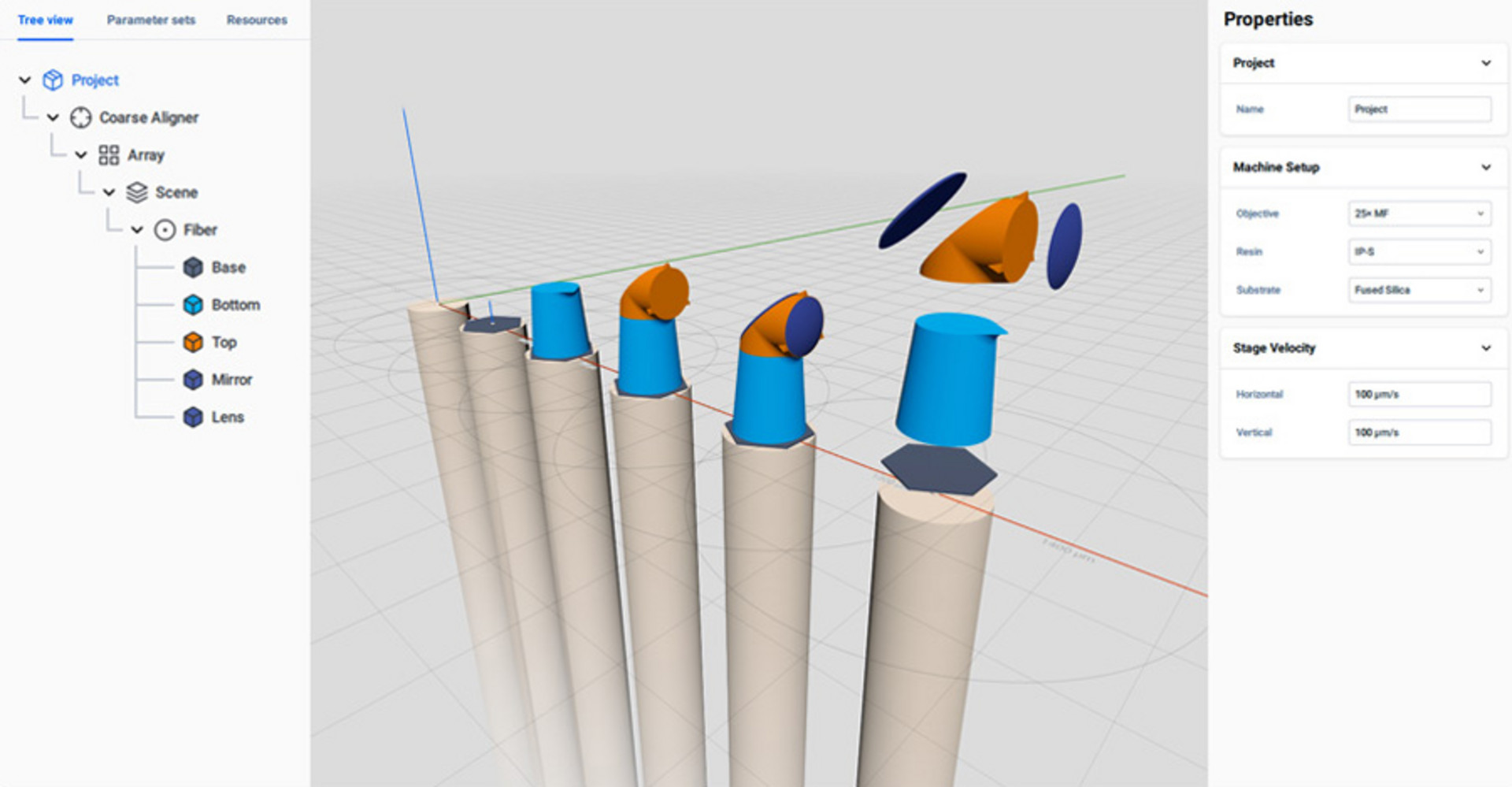
Nanoscribe systems operate with the nanoPrintX software, which provides a graphical user interface to configure alignment and printing processes. Within nanoPrintX, alignment routines are defined in a tree-structured workflow. A dedicated fiber node automatically detects the fiber core and sets it as a reference, so all assigned structures are printed relative to this position. Microoptical elements are thus fabricated in situ and automatically aligned to the fiber core without manual intervention, ensuring high repeatability and enabling efficient batch processing.
What types of optical fibers work with Quantum X align?
Nanoscribe Quantum X align supports printing on a wide range of types of optical fibers, including:
-
Single-mode fibers (SMF)
-
Multimode fibers (MMF)
-
Polarization-maintaining (PM) fibers
-
Cleaved fibers mounted in FC/PC connectors
-
Fiber arrays (e.g., V-groove assemblies, 4 x 8 fibers, others on request)
-
Multicore fibers
-
Fiber bundles
For further information on additional fiber types, please contact us at sales@nanoscribe.com
How robust are 3D-printed micro-optics on optical fibers?
3D-printed micro-optics on optical fibers have demonstrated high robustness in standardized environmental tests. Free-space optical coupling elements such as periscopic lenses and collimating lenses 3D-printed onto a SF28 fiber array were tested under damp heat conditions (85 °C / 85 % RH for 1,000 h).
Coupling performance was assessed using the periscopes, where light was transmitted from one fiber through two periscopes on adjacent fibers and coupled back into the second fiber. The coupling loss was measured before and after damp heat exposure and showed excess loss ≤ 0.3 dB per coupling interface. The emission beam was characterized on the 3D-printed collimating lens by using a beam profiler, and the Gaussian beam fit at the beam waist was compared. The mode field diameter (MFD) changed by only 1.3% on average after testing.
In addition, microoptical elements passed temperature cycling tests from –20 °C to +125 °C over hundreds of cycles. These tests evaluate the material and structural stability of the printed micro-optics. Neither optical performance nor mechanical integrity, including shape stability and adhesion to the substrate, showed any measurable change. These results confirm their suitability for demanding applications that require
Get your project started with our products

Quantum X align
Aligned 3D printing for integrated photonics & optics

Optics manufacturing materials
Resins optimized for fabrication of microoptical elements
Discover the potential of micro-optics on fibers
Get inspired by these scientific highlight publications, showcasing micro-optics on fibers created with Nanoscribe’s high-resolution 3D printing technology. For even more insights, explore over 2,500 peer-reviewed scientific publications in our premium resources section – simply log in or register for free.
Side-looking endoscopic micro-optics: comparison between state-of-the-art two-photon polymerization printing techniques

Jan Niklas Bauer, Leander Siegle, Claudia Imiolczyk, Pavel Ruchka, and Harald Giessen
4th Physics Institute and Research Center SCoPE, University of Stuttgart, School of Electrical and Mechanical Engineering and Institute for Photonics and Advanced Sensing, The University of Adelaide
Optics Express 33, 33473-33482 (2025)
3D-printed micro-axicon enables extended depth-of-focus intravascular...
P. Ruchka, A. Kushwaha, J. A. Marathe, L. Xiang, R. Chen, R. W. Kirk, J. T. M. Tan, C. Bursill, J. Verjans, S. Thiele, R. Fitridge, R. A. McLaughlin, P. J. Psaltis, H. Giessen, J. Li
Uni Stuttgart, Uni Adelaide, Printoptix
Advanced Photon. 7(2) 026003 (3 March 2025)
An achromatic metafiber for focusing and imaging across the entire...
H. Ren, J. Jang, C. Li, A. Aigner, M. Plidschun, J. Kim, J. Rho, M. A. Schmidt & S. A. Maier
Monash University, Ludwig Maximilian University of Munich, POSTECH, Leibniz Institute of Photonic Technology, FSU Jena, Imperial College London
Nature Communications 13, 4183 (2022)
3D-printed fiber-based zeroth- and high-order Bessel beam generator
Innem V. A. K. Reddy, Andrea Bertoncini, Carlo Liberale
King Abdullah University of Science and Technology, University at Buffalo
Optica 9, 645-651 (2022)