


3D-printed microfluidic components
High-resolution 3D microprinting enables the fabrication of complex microfluidic components with submicron precision and excellent surface quality. With automatic alignment, Quantum X systems enable true in-situ fabrication – printing functional structures directly inside microfluidic chips, wells, and prepatterned substrates in a single manufacturing step.
Advanced 3D microfluidic components, printed in a single workflow

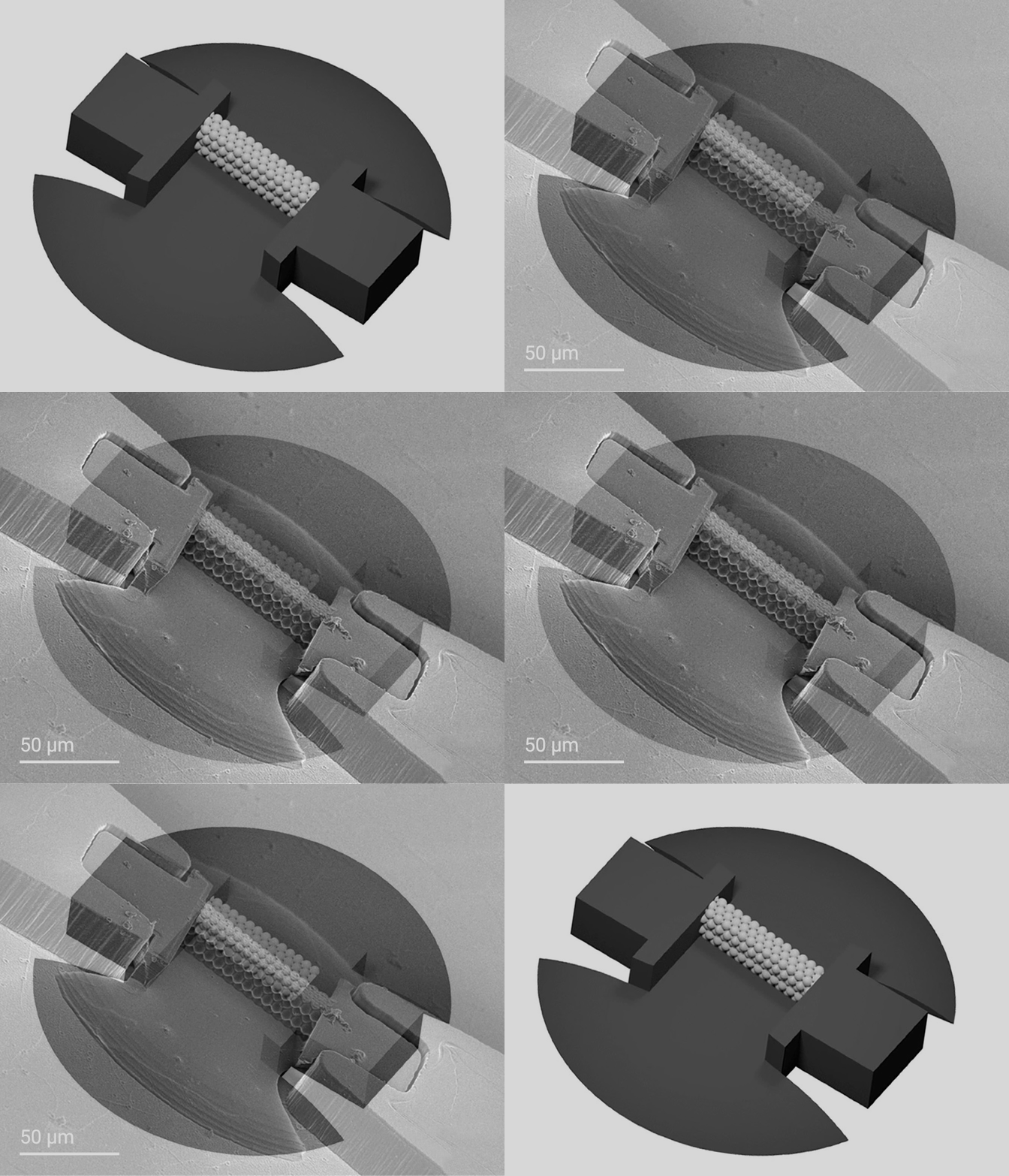
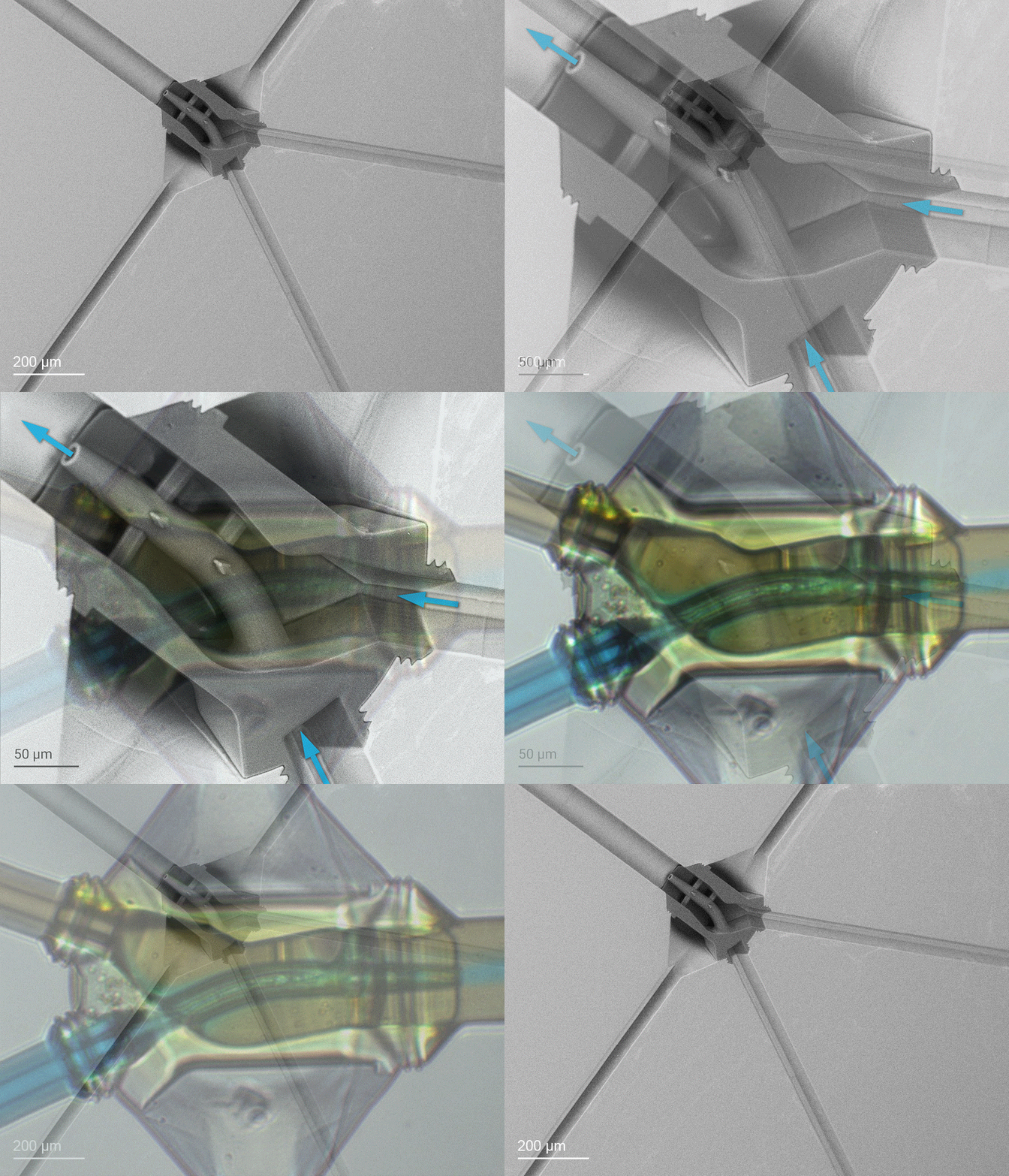
High-resolution 3D printing of microfluidic components
Microfluidics enables precise control of minute fluid volumes and underpins applications in biomedical research, drug development, and materials science. In medical and biofabrication contexts, microfluidics is central to lab-on-a-chip and organ-on-a-chip platforms as well as point-of-care diagnostics, where precise control over fluid dynamics and cell-material interactions is critical.
While many microfluidic devices are fabricated using planar or multilayer processes, advanced functionalities – such as 3D flow manipulation, in-channel mixing elements, integrated micro-optics, or engineered cell microenvironments – require complex 3D geometries with high surface quality and accurate spatial placement. Achieving this level of complexity using traditional methods can be technically demanding and restrictive.
Nanoscribe’s Two-Photon Polymerization (2PP) technology overcomes these limitations. With submicron precision, excellent surface quality, and aligned 3D printing directly inside microfluidic channels or on prefabricated substrates, 2PP enables the seamless integration of functional 3D microstructures, unlocking new design possibilities for next-generation microfluidic devices.
3D microprinting beyond planar microfluidic designs
Nanoscribe’s Quantum X systems enable the fabrication of complex microfluidic components and systems with new functional 3D geometries. Leveraging Nanoscribe’s proprietary Dip-in Laser Lithography (DiLL) combined with automated alignment, functional 3D microstructures can be fabricated even inside deep and narrow microfluidic channels, including micronozzles, microvalves, micromixers, optofluidic elements, and extracellular microenvironments.
Using 3D printing by Two-Photon Grayscale Lithography (2GL®), microfluidic structures can be fabricated with precisely tailored surface properties, ranging from smooth topographies for precise flow control to defined roughness levels for enhanced cell adhesion.
The specific application advantages of Quantum X systems in detail:
-
High throughput without compromising quality: 2GL® enables fast printing of 3D objects at high quality across scales from nano- to mesoscale, including high-aspect-ratio elements, micronozzles, microvalves, and filigree lattice structures.
-
Automatic alignment: High-precision alignment enables direct printing onto prepatterned substrates relative to fiducials and within commercial or custom microfluidic chips and wells.
-
Software-supported alignment workflow: nanoPrintX provides a tree-like organization of alignment routines and print objects. A graphical user interface (GUI) visualizes structure placement, enabling efficient preparation of even complex print projects.
-
Wide mechanical property range: Nanoscribe’s photoresins span Young’s moduli from MPa to GPa, supporting both soft, elastic structures and stiff microfeatures.
-
3D printing inside deep channels: Dip-in Laser Lithography enables complex 3D geometries inside deep and narrow microfluidic channels, with working distances exceeding 300 µm at submicron precision and over 2 mm at micrometer precision.
-
Tailored surface topographies: Nanoscribe’s patented 2GL® technology enables direct surface structuring during printing, ranging from ultra-smooth finishes to functional textures using more than 4,000 gray levels.
-
Microfluidic template fabrication: 3D-printed polymer structures can serve as masters for PDMS molding or electroplating, supporting rapid prototyping, functional validation, and scalable replication of microfluidic devices.
Your questions answered: 3D printing of microfluidics
How does in-situ 3D printing work in microfluidics?
In-situ 3D printing in microfluidics is enabled by Nanoscribe’s proprietary Dip-in Laser Lithography (DiLL), in which the microscope objective is dipped directly into the liquid photoresin, creating refractive-index matching along the optical path, minimizing optical aberrations from base to top of the structure.
Combined with long working-distance optics and automatic alignment, DiLL enables microstructures to be fabricated directly inside microfluidic chips, deep channels or wells, and prepatterned substrates. The Quantum X system maps the substrate, detects fiducials, and prints structures aligned to the detected fiducials in a single manufacturing step.
How can 3D printing enhance microfluidic mixing?
In microfluidics, low Reynolds numbers lead to laminar flow, where fluids mix predominantly by diffusion due to the absence of turbulence. Enhancing mixing therefore requires geometric or surface-based features that actively disturb the flow.
Using 3D printing by 2GL®, such features can be fabricated directly inside microchannels with high throughput. Complex 3D mixing geometries promote fluid folding and stretching, while tailored surface topographies modify wettability across hydrophilic to hydrophobic regimes, thereby influencing local flow behavior and mixing efficiency.
For more details on the design and manufacturing of material textures, read the publication:
Direct Laser Writing of Fractal Surfaces: Strategy to Design and Manufacture Textured Materials
Is it feasible to replicate 3D-printed microfluidic masters in PDMS?
Yes. Microfluidic structures fabricated by 2PP-based microfabrication can serve as high-precision masters for PDMS replication in soft lithography. The polymer master is printed on a flat substrate, enabling 2.5D geometries such as microchannels with smooth surfaces, height gradients, and sharp feature definition that are difficult to achieve with conventional lithography processes.
After development, liquid PDMS is cast onto the printed master, degassed and thermally cured. The cured PDMS replica is then peeled off and plasma-bonded to a glass substrate, resulting in enclosed microfluidic channels that accurately replicate the original master geometry
Get your project started with our products

Quantum X shape
Most versatile, powerful system for advanced research

High-resolution 3D printing materials
High-resolution 3D printing of complex microstructures
Discover the potential of microfluidics
Get inspired by these scientific highlight publications, showcasing microfluidic components created with Nanoscribe’s high-resolution 3D printing technology. For even more insights, explore over 2,500 peer-reviewed scientific publications in our premium resources section – simply log in or register for free.
Droplet‐Based Synthesis of Nanogels for Controlled Drug Delivery via Two Photon Polymerization‐3D Printed Microfluidic Device

Vladimir Matining, Camillo Colli, Emanuela Jacchetti, Giulia Nicoletti, Laura Rosanò, Manuela Teresa Raimondi, Bianca Maria Colosimo, Emanuele Mauri, Davide Moscatelli
Politecnico di Milano, National Research Council (CNR)
Advanced Materials Technologies 10, no. 19 (2025): e00108
NOVAsort for error-free droplet microfluidics
Han Zhang, Rohit Gupte, Yuwen Li, Can Huang, Adrian R. Guzman, Jeong Jae Han, Haemin Jung, Rushant Sabnis, Paul de Figueiredo & Arum Han
Texas A&M University, University of Missouri
Nature Communications 15, 9444 (2024)
A unique coaxial lamination mixer (CLM) enabled by two-photon polymerization ...
Peer Erfle, Juliane Riewe, Heike Bunjes, Andreas Dietzel
Technische Universität Braunschweig
Lab on a Chip, 2021,21, 2178-2193
Ultracompact 3D microfluidics for time-resolved structural biology
J. Knoška, L. Adriano, S. Awel, K. R. Beyerlein, O. Yefanov, D. Oberthuer, G. E. Peña Murillo, N. Roth, I. Sarrou, P. Villanueva-Perez, M. O. Wiedorn, F. Wilde, S. Bajt, H. N. Chapman, M. Heymann
DESY, Universität Hamburg, Universität Stuttgart, European XFEL, MPI - MPSD
Nature Communications 11, 657 (2020)
3D nanofabrication inside rapid prototyped microfluidic channels
Lölsberg, J., Linkhorst, J., Cinar, A., Jans, A., Kuehne, A. J. C., Wessling, M.
DWI Leibniz Institute for Interactive Materials, RWTH Aachen
Lab on a Chip, 2018,18, 1341-1348
On-chip mixing of liquids with swap structures written by two-photon ...
Martin Oellers, Frieder Lucklum & Michael J. Vellekoop
University of Bremen
Microfluid Nanofluid 24, 4 (2020)
Microfluidics at Fiber Tip for Nanoliter Delivery and Sampling
Antoine Barbot Dominic Wales Eric Yeatman Guang‐Zhong Yang
Imperial College London, Shanghai Jiao Tong University
Advanced Science, 2021, 8, 2004643