

Optical metamaterials
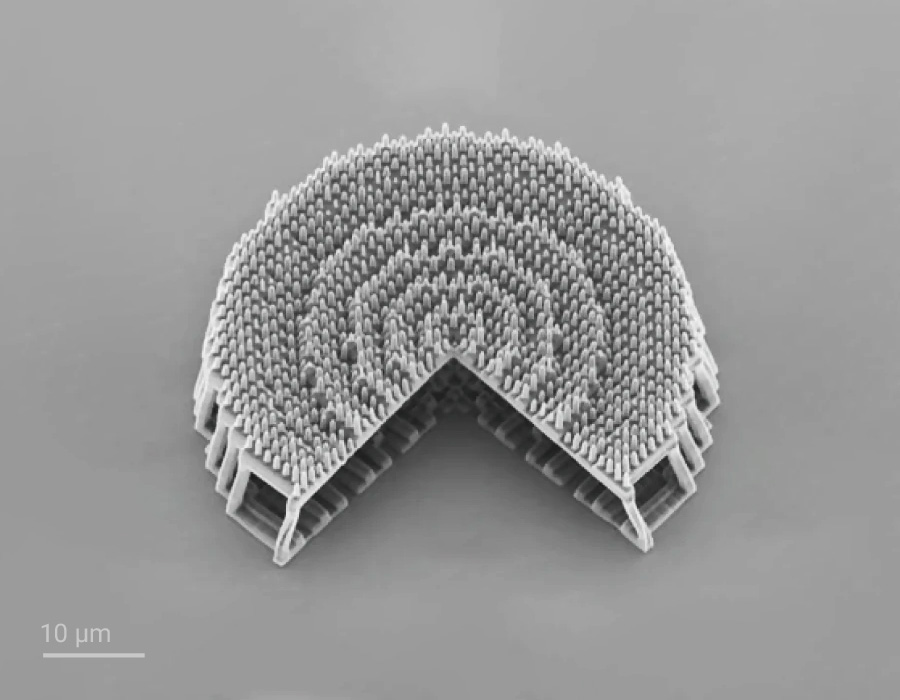
Rationally designed artificial materials with tailored optical responses are redefining what is possible in photonics. As metamaterial designs move beyond planar structures, true 3D fabrication at the highest resolution becomes essential. Nanoscribe’s Quantum X systems provide exactly that, enabling complex 3D geometries for photonic crystals, optical metamaterials, and metalenses.
Advancing optical metamaterials through 3D fabrication
High-resolution 3D printing for optical metamaterials and metalenses
Metamaterials and metalenses enable unprecedented control of light by structuring materials at subwavelength scales, surpassing the limits of conventional refractive optics. These engineered optical elements offer functionalities such as achromatic imaging, polarization control, and compact system integration, but their full potential is often constrained by fabrication limits.
From planar nanofabrication to true 3D photonic structures
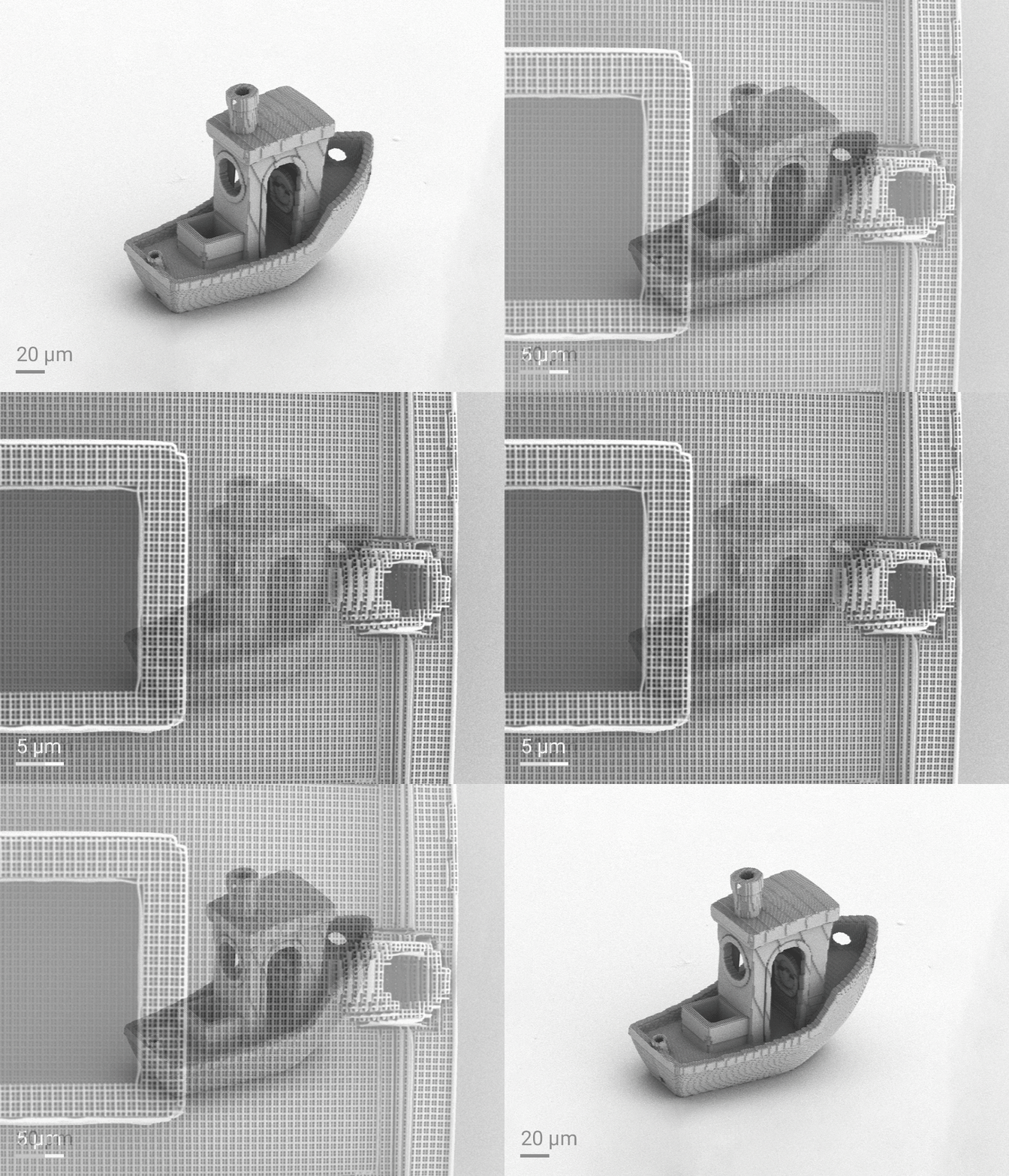
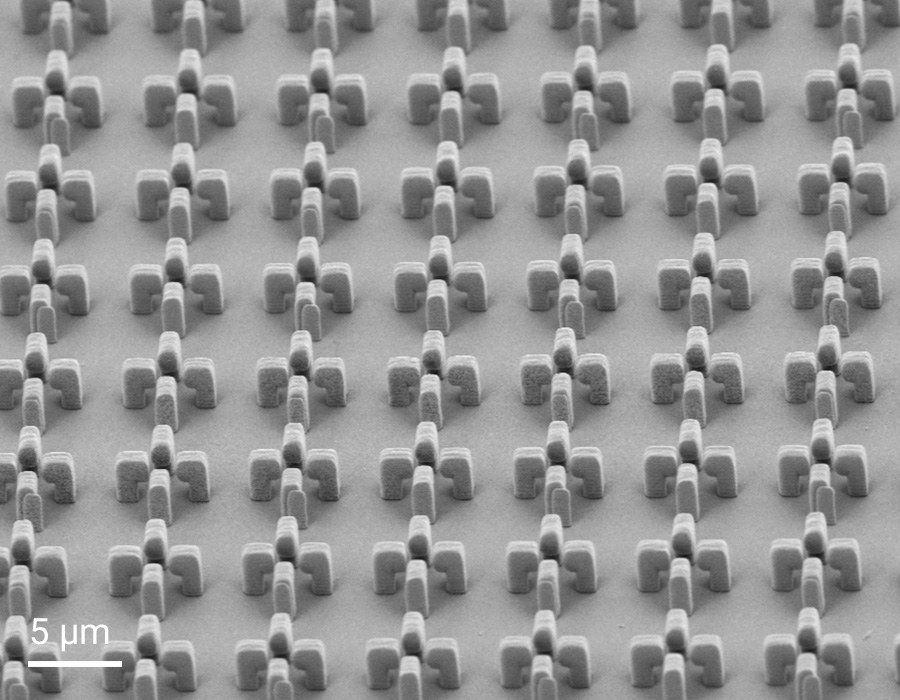
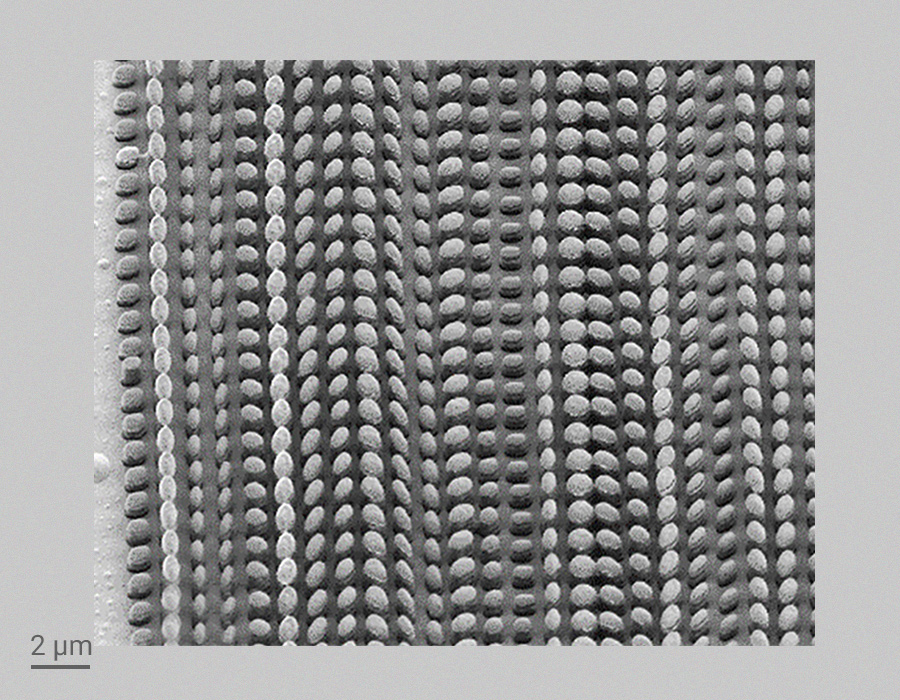
Conventional fabrication approaches for subwavelength structures, such as electron-beam lithography and etching, are typically restricted to planar geometries with low aspect ratios and are often limited to conductive substrates. Nanoscribe’s Two-Photon Polymerization (2PP), originally developed specifically for the fabrication of optical metamaterials, overcomes these limitations by providing true 3D fabrication with submicrometer feature sizes and precise control over geometry, height, and spatial arrangement of meta-atoms.
This design freedom is key to advanced concepts such as hybrid achromatic metalenses, where metasurfaces and phase elements are combined into a single structure to minimize chromatic aberrations across broad spectral ranges. Beyond planar designs, Nanoscribe’s Quantum X systems enable the fabrication of volumetric optical metamaterials and photonic crystals with engineered optical responses.
Combined with post-processing techniques such as atomic layer deposition (ALD), chemical vapor deposition (CVD) or metal coating, 3D-printed polymer templates can be converted into high-performance metallic or dielectric metamaterials.
Quantum X systems for optical metamaterials and metalenses
Quantum X systems provide the precision and 3D design freedom required to realize optical metamaterials:
-
Dip-in Laser Lithography (DiLL) with tailored photoresins: Nanoscribe’s proprietary DiLL technology with refractive index matching photoresins for aberration-free printing of high-resolution 3D structures.
-
Submicron resolution for optical functionality: Enabling operation across visible, near-infrared (NIR), and infrared (IR) wavelengths.
-
Material versatility and post-processing compatibility: Supports Nanoscribe’s validated photoresins for high-resolution printing as well as third-party and custom materials such as titania-ion doped resins. Compatible with post-processing techniques including ALD, CVD, evaporation and electroplating.
-
Seamless integration on substrates and components: Direct printing on wafers, fibers, chips, and a wide range of substrates, including non-conductive, opaque and transparent materials, enables compact and integrated optical systems.
-
Enhanced optical performance: Precise control of geometry improves phase control, reduces chromatic aberrations, and increases efficiency.
-
High precision and repeatability: Galvo-based positioning and a granite-based vibration isolation system ensure reliable 3D printing of repeatable high-resolution structures, critical for scalable meta-optics fabrication.
Your questions answered: 3D printing of optical metamaterials
Can polymer-based 2PP structures be used for metamaterials and metalenses?
Yes. Polymer-based 2PP structures are widely used for prototyping, design validation, and proof-of-concept studies in metamaterials and metalenses. They enable researchers to fabricate highly precise submicron features and complex 3D geometries that are difficult to achieve with conventional planar fabrication methods. For many applications, this makes them a powerful platform for exploring optical concepts, validating simulations, and testing advanced meta-optical designs. When higher refractive index contrast or additional optical functionality is required, the printed structures can also serve as templates for post-processing steps such as metallization, atomic layer deposition, or material conversion.
Can simulated designs of metamaterials and metalenses be fabricated using Quantum X systems?
Yes. The 2PP workflow is highly compatible with simulation tools used for optical metamaterials and metalenses. Most designs are created using electromagnetic simulations such as finite-difference time-domain (FDTD), finite-element method (FEM), or rigorous coupled-wave analysis (RCWA), which output fully three-dimensional geometries or height profiles. These geometries can be transferred directly into the 2PP workflow as 3D meshes, scripts and grayscale images as data input.
A key advantage of 2PP is that it allows designers to fabricate the same 3D geometries that are used in simulations, including curved phase profiles, smooth height gradients, and volumetric unit cells, reducing the design–fabrication gap with consistent fabrication.
Can Quantum X systems fabricate stacked and hybrid metalens designs?
Yes. Quantum X enables true 3D fabrication of stacked and hybrid metalens designs within a monolithic workflow. This allows multiple optical functions to be integrated into one inherently self-aligned structure, reducing assembly effort and improving geometric precision. Precise control over layer height, axial spacing, and lateral features makes the technology especially attractive for compact, broadband, and multifunctional meta-optical concepts such as hybrid achromatic metalenses.
Get your project started with our products

Quantum X shape
Most versatile, powerful system for advanced research

High-resolution 3D printing materials
High-resolution 3D printing of complex microstructures
Discover the potential of optical metamaterials
Get inspired by these scientific highlight publications, showcasing optical metamaterials created with Nanoscribe’s high-resolution 3D printing technology. For even more insights, explore over 2,500 peer-reviewed scientific publications in our premium resources section – simply log in or register for free.
Printing of 3D photonic crystals in titania with complete bandgap across the visible spectrum

W. Zhang, J. Min, H. Wang, H. Wang, X. Liang Li, S. Tung Ha, B. Zhang, C. Pan, H. Li, H. Liu, H. Yin, X. Yang, S. Liu, X. Xu, C. He, H. Ying Yang & J. K. W. Yang
Singapore University of Technology and Design, National University of Singapore, United Microelectronics Center (CUMEC), Hunan University, Technology and Research (A*STAR), Northwestern Polytechnical University, National University of Singapore
Nature Nanotechnology 19, 1813–1820 (2024)
A hybrid achromatic metalens
F. Balli, M. Sultan, Sarah K. Lami, J. T. Hastings
University of Kentucky, Lexington
Nature Communications 11, 3892 (2020)
Polarization-independent actively tunable colour generation on imprinted...
D. Franklin, Y. Chen, A. Vazquez-Guardado, S. Modak, J. Boroumand, D. Xu, S. Wu, D. Chanda
University of Central Florida
Nature Communications 6, 7337 (2015)
Gold Helix Photonic Metamaterial as Broadband Circular Polarizer
J. K. Gansel, M. Thiel, M. S. Rill, M. Decker, K. Bade, V. Saile, G. von Freymann, S. Linden, M. Wegener
Institut für Angewandte Physik and DFG-Center for Functional Nanostructures (CFN), Universität Karlsruhe
Science 325,1513-1515(2009)