


Functional resin development
Since material properties correlate directly with the scope of applications, resin formulations play a key role in innovation. New developments of Two-Photon Polymerization (2PP) materials open up broader opportunities, as the open material platform Quantum X allows for rapid iteration, testing, and use of functional resins for high-resolution 3D printing, including custom formulations.
Engineering the next generation of functional 2PP materials
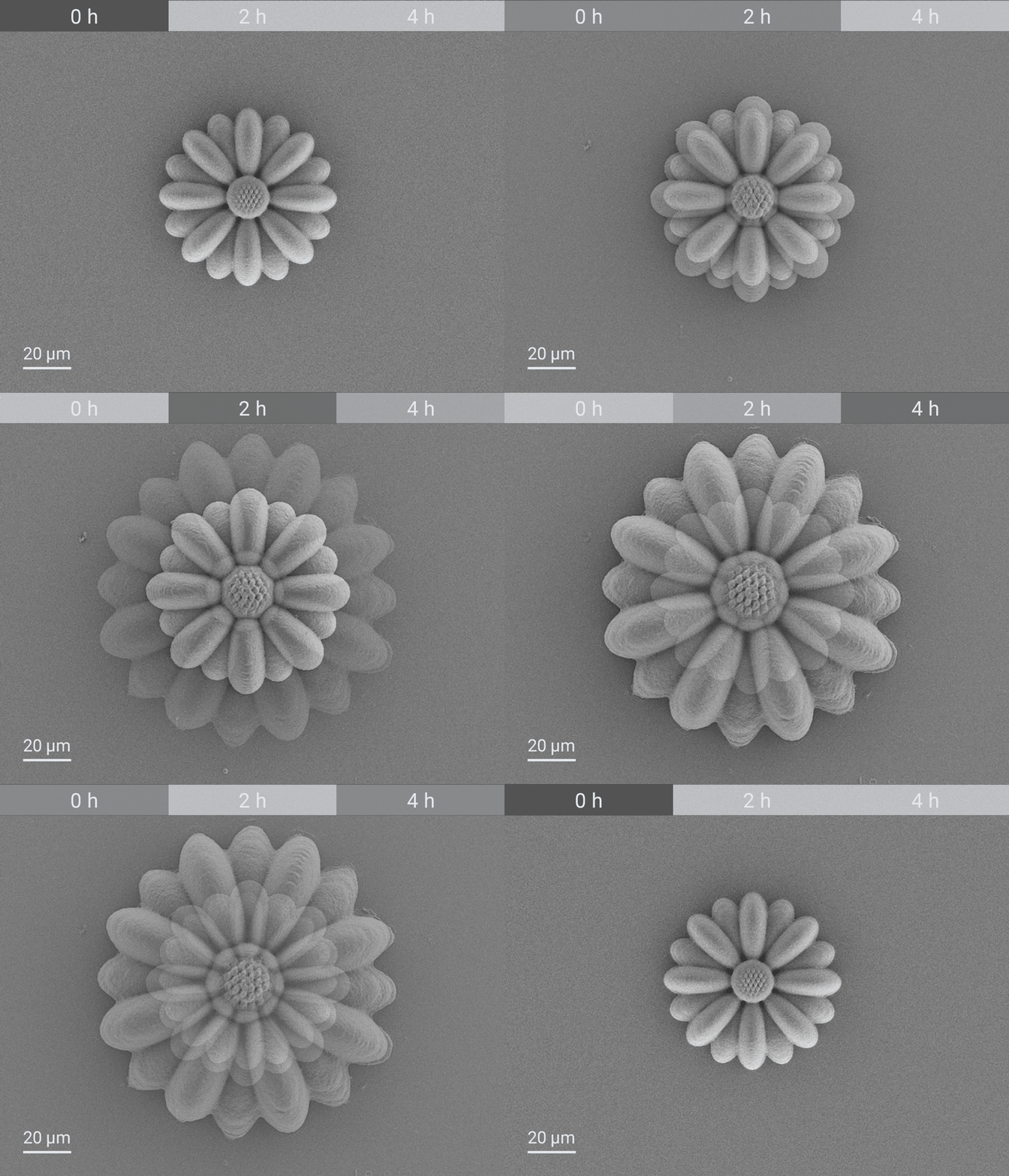


Functional resins for expanding 2PP possibilities
While many standard resins for high-resolution 3D printing are commercially available off the shelf, pioneering research often requires custom materials. New materials are developed not only to meet specific application needs but also as part of fundamental research to explore novel chemistries or expand the 2PP material toolbox.
Unlocking unique applications through material innovation
Two-Photon Polymerization enables ultra-precise 3D structuring at the microscale, and its underlying chemistry is remarkably adaptable. Researchers can design entirely new material systems by synthesizing novel monomers or photoinitiators, or by combining existing components into 2PP-active formulations.
Functional resin development expands the scope of 2PP to new material classes. Many advanced systems, such as those used in 4D printing – where time acts as the fourth dimension and printed objects change their properties in response to external stimuli – or smart materials, still rely on radical polymerization. However, alternative reaction mechanisms are gaining traction.
This flexibility unlocks entirely new functional properties, including degradable microstructures, highly biocompatible prints, and resins with precisely tuned mechanical, or conductive properties.
Quantum X is an open material platform that provides full flexibility in material choice. It is ideal for high-resolution 3D printing with Nanoscribe resins, third-party materials, and custom-developed formulations, all supported by dedicated tools for resin management and process optimization.
Quantum X printers are ready for targeted material development and optimization:
-
Resin library: Define and manage resin candidates both directly on the printer and in the printer software.
-
Parameter scans: Conduct systematic parameter sweeps with intuitive tools to quickly and reproducibly optimize the printing process.
-
Live monitoring & first-look analysis: Observe print progress in real time through the integrated high-resolution camera for immediate visual feedback before detailed post-analysis.
-
Efficient iteration: Adapt resin compositions, exposure settings, and process parameters within flexible test workflows to accelerate development cycles.
-
From prototype to recipe: Fine-tune successful resin candidates and implement ready-to-use printing recipes for consistent results across all project specifications.
-
Aligned printing on various substrates: Benefit from aligned 3D printing to fabricate structures directly on slides, wafers, chips, or inside microfluidic wells and dishes with submicron precision.
-
Outstanding accuracy and surface quality: Achieve superior results through 2GL® printing, combining highly defined structures and exceptionally smooth surfaces with ultra-fast microfabrication for efficient iteration cycles.
Frequently asked questions about functional resin development
Can you control resin temperature while printing?
Yes. Equipped with the bioprinting chamber, Quantum X bio provides precise temperature control, ideal for temperature-sensitive applications. The bioprinting chamber maintains optimal conditions for bioresins and other specialized materials, including humidity and gas flow control, making it especially useful for cell encapsulation where a stable and sterile environment is essential. It is also available as an optional add-on for Quantum X shape, enhancing flexibility for advanced micro- and biofabrication tasks.
For more details, see our Quantum X bio page.
What resin viscosity range works with 2PP?
Two-Photon Polymerization (2PP) supports a wide range of resin viscosities – from low-viscosity fluids (~ 10 mPa·s) to highly viscous, honey-like formulations (> 10,000 mPa·s), depending on the setup and application. Low-viscosity resins enable highest resolution and fine feature definition, while high-viscosity resins provide improved mechanical stability and efficient curing.
Can I test my own resin on Nanoscribe printers?
Yes. Nanoscribe systems are designed as open material platforms for third-party and custom resins. Users can create and manage their own resin libraries, test candidates with the parameter sweep function to identify optimal exposure settings, and iterate efficiently within flexible workflows – with optional guidance from our Customer Success Team for testing individual materials.
We additionally offer a portfolio of many proprietary resins designed for high-performance printing in key application areas:
In addition, we offer qualified partner materials from:
Get your project started with our products

Quantum X shape
Most versatile, powerful system for advanced research

Printing materials
High-performance 2PP photoresins for every application
Discover the potential of functional resin development
Get inspired by these scientific highlights showcasing microoptics created with Nanoscribe’s high-resolution 3D printing technology. Explore even more insights in over 2,500 peer-reviewed scientific publications in our premium resources section – simply log in or register for free.
A Facile Approach for 4D Microprinting of Multi-Photoresponsive Actuators

Li-Yun Hsu, Philipp Mainik, Alexander Münchinger, Sebastian Lindenthal, Tobias Spratte, Alexander Welle, Jana Zaumseil, Christine Selhuber-Unkel, Martin Wegener, Eva Blasco
Heidelberg University, Germany; Karlsruhe Institute of Technology (KIT), Germany
Advanced Materials Technologies, 8, 2200801 (2023)
Microscale generation and control of nanosecond light by light in a liquid...
Mahendran Vellaichamy, Uroš Jagodič, Jaka Pišljar, Jaka Zaplotnik, Urban Mur, Andreja Jelen, Andriy Nych, Deepshika Malkar, Anna V. Ryzhkova, Miha Škarabot, Miha Ravnik & Igor Muševič
Condensed Matter Department, J. Stefan Institute, Ljubljana, Slovenia
Nature Photonics 19, 758–766 (2025)
Imaging-guided bioresorbable acoustic hydrogel microrobots
Hong Han, Xiaotian Ma, Weiting Deng, Junhang Zhang, Songsong Tang, On Shun Pak, Lailai Zhu, Ernesto Criado-Hidalgo, Chen Gong, Emil Karshalev, Jounghyun Yoo, Ming You, Ann Liu, Canran Wang, Hao K. Shen, Payal N. Patel, Claire L. Hays, Peter J. Gunnarson
Caltech
Science Robotics 9, eadp3593 (2024)
Low-temperature 3D printing of transparent silica glass microstructures
M. Li, L.Yue, A. C. Rajan, L. Yu, H. Sahu, S. Macrae Montgomery, R. Ramprasad, H. Jerry Qi
The George W. Woodruff School of Mechanical Engineering, Georgia Institute of Technology, Atlanta, GA 30332, USA; School of Materials Science and Engineering, Georgia Institute of Technology, Atlanta, GA 30332, USA
Science Advances 9, eadi2958 (2023)