

Low-loss optical couplers for photonics packaging
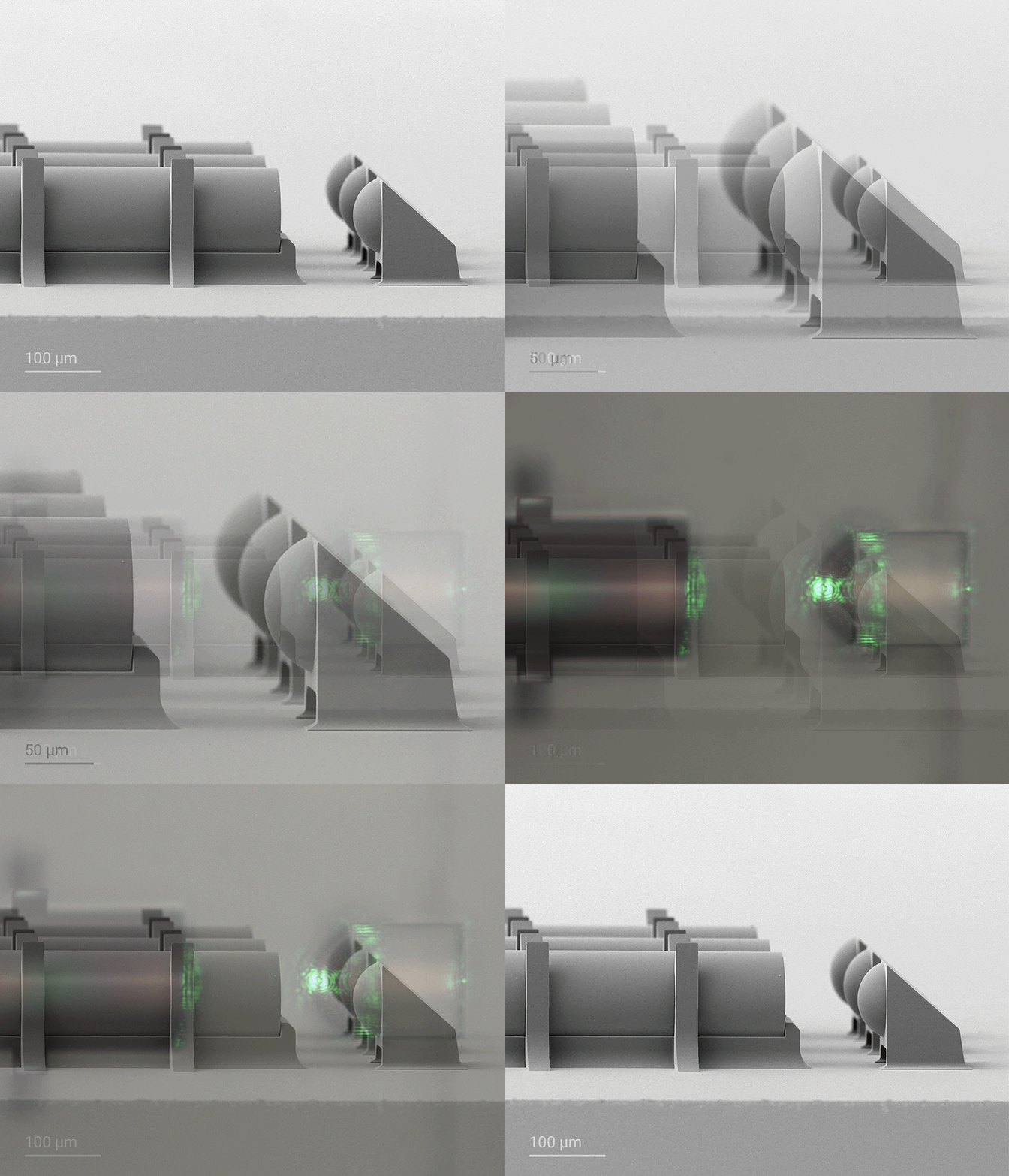
Low loss optical coupling is essential for scalable photonic integration as the industry advances from pluggable transceivers to co-packaged optics. Quantum X align is designed to address this challenge by combining Two-Photon Polymerization with automated alignment to fabricate freeform optical couplers on chips and fibers, enabling low-loss, scalable photonic integration.
Tailored optical coupler designs


Solving the optical coupling bottleneck
As demand for optical interconnects grows across AI, high-performance computing, and data center applications, co-packaged optics (CPO) drives higher I/O density, making efficient optical coupling a key challenge. Low-loss optical coupling between photonic integrated circuits (PICs), optical fibers, and active photonic devices requires both precise alignment and manufacturing flexibility. Quantum X align addresses this challenge with automatically aligned, 3D-printed freeform micro-optics that reduce losses, increase alignment tolerance, and support scalable photonics packaging.
3D-printed optics for scalable photonic coupling
Optical couplers efficiently transfer light between fibers, photonic integrated circuits (PICs), and other photonic components. 3D-printed micro-optics enable a wide range of coupling schemes, including fiber-to-chip coupling, chip-to-chip edge coupling, laser-to-chip coupling, and surface coupling via grating couplers.
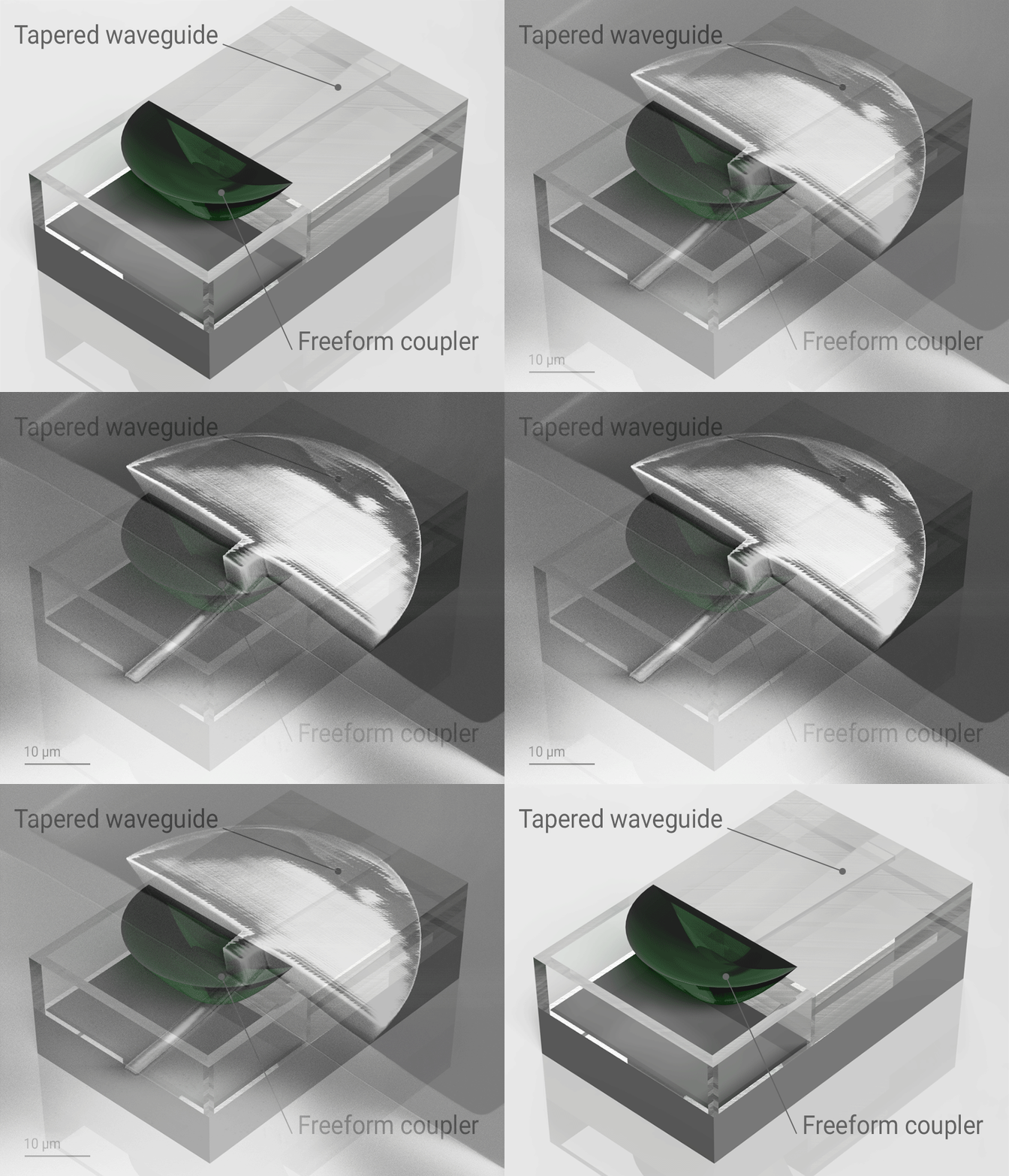
Mode-field diameter (MFD) mismatches between on-chip waveguides and single-mode fibers require precise mode adaptation and alignment for low-loss coupling. 3D-printed freeform optical elements can be fabricated directly on fibers, PICs, and other photonic components, enabling flexible designs for beam shaping and mode-field adaptation, reducing insertion loss while increasing alignment tolerance and packaging robustness. This makes 3D-printed optical couplers a scalable solution for photonics packaging and next-generation CPO architectures.
Key advantages of Quantum X align for optical couplers
Quantum X align enables low-loss optical coupling with sub-dB losses and increased alignment tolerance, supporting scalable photonics packaging and next-generation optical interconnects. By combining automated alignment with high-throughput 3D printing by Two-Photon Grayscale Lithography (2GL®), it fabricates tailored freeform micro-optics directly on chips and fibers, simplifying integration while maintaining the flexibility required for advanced photonic devices.
-
Tailored freeform beam-shaping optics enable low-loss expanded-beam coupling, improved mode-field matching, and increased alignment tolerance for passive alignment.
-
Automatic alignment to fiber cores, chip edges, and on-chip fiducials enables precise structure placement with detection accuracies down to 100 nm, depending on the alignment target. Patented beam-shadow compensation enables direct printing of beam expanders on chip edges.
-
3D printing by 2GL® enables rapid fabrication of high-precision freeform micro-optics with excellent shape accuracy and optical-quality surface (Ra down to 5 nm), achieving print speeds up to 60× faster than classic Two-Photon Polymerization (2PP).
-
Scalable manufacturing with high-throughput processing of up to 4 × 8 fibers in a single print run and wafer-level aligned 3D printing on substrates up to 150 × 150 mm², including up to 8-inch wafers and individual dies.
-
Broad component compatibility with major PIC platforms such as SiN, Si, SOI, InP, GaAs, and TFLN and optical fibers, including single-mode fibers (SMF), multimode fibers (MMF), multicore fibers, fiber bundles, polarization-maintaining (PM) fibers, and fiber arrays.
-
Validated photoresins with high transparency from UV to NIR wavelengths, tailored optical properties, and proven long-term environmental reliability.
-
Intuitive nanoPrintX software with visual job setup and real-time feedback simplifies both routine and complex alignment workflows.
Your questions answered: 3D printing of optical couplers
How can 3D-printed micro-optics reduce coupling losses?
3D-printed freeform optics can tailor optical mode profiles between fibers, lasers, and photonic integrated circuits (PICs). By improving mode matching and increasing alignment tolerances, they reduce insertion losses while simplifying assembly and supporting passive alignment strategies. Compared with conventional edge couplers, tailored freeform optics can provide higher coupling efficiency and greater alignment tolerance, while offering wider optical bandwidth and lower polarization sensitivity than grating couplers.
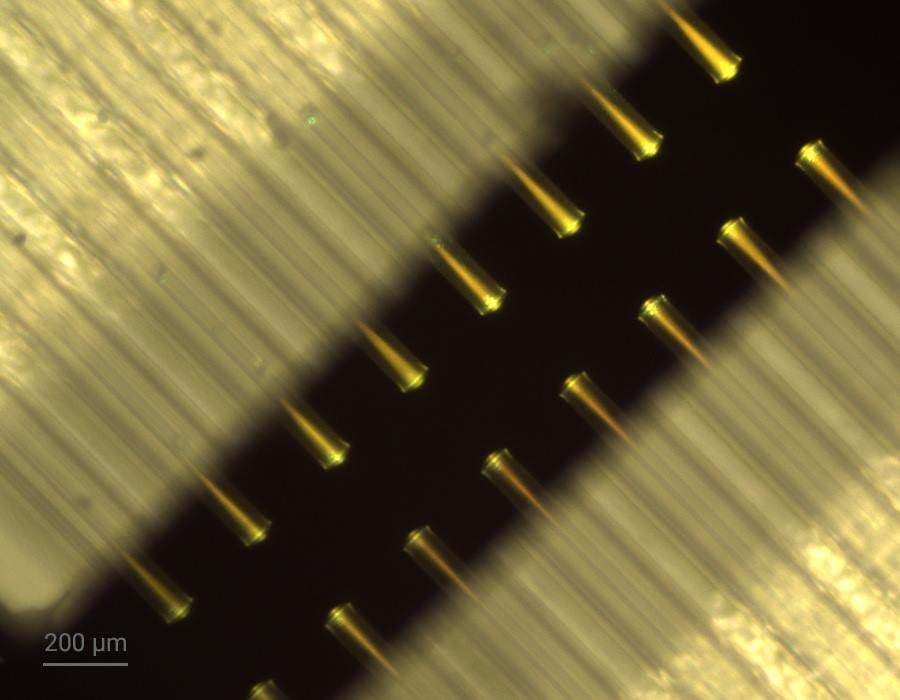
For example, collimating freeform microlenses printed directly onto a silicon-on-insulator (SOI) chip and on a standard SMF28 fiber array with 127 µm pitch achieved coupling losses as low as 1.35 dB while enabling efficient coupling over large working distances.

How does expanded-beam coupling improve alignment tolerances?
Expanded-beam coupling elements enlarge the optical mode before transmission, making the interface less sensitive to lateral misalignment. This increases alignment tolerance, simplifies assembly, improves packaging robustness, and can support passive alignment strategies by reducing the need for active alignment.
How can 3D printing produce hollow-core optical waveguides?
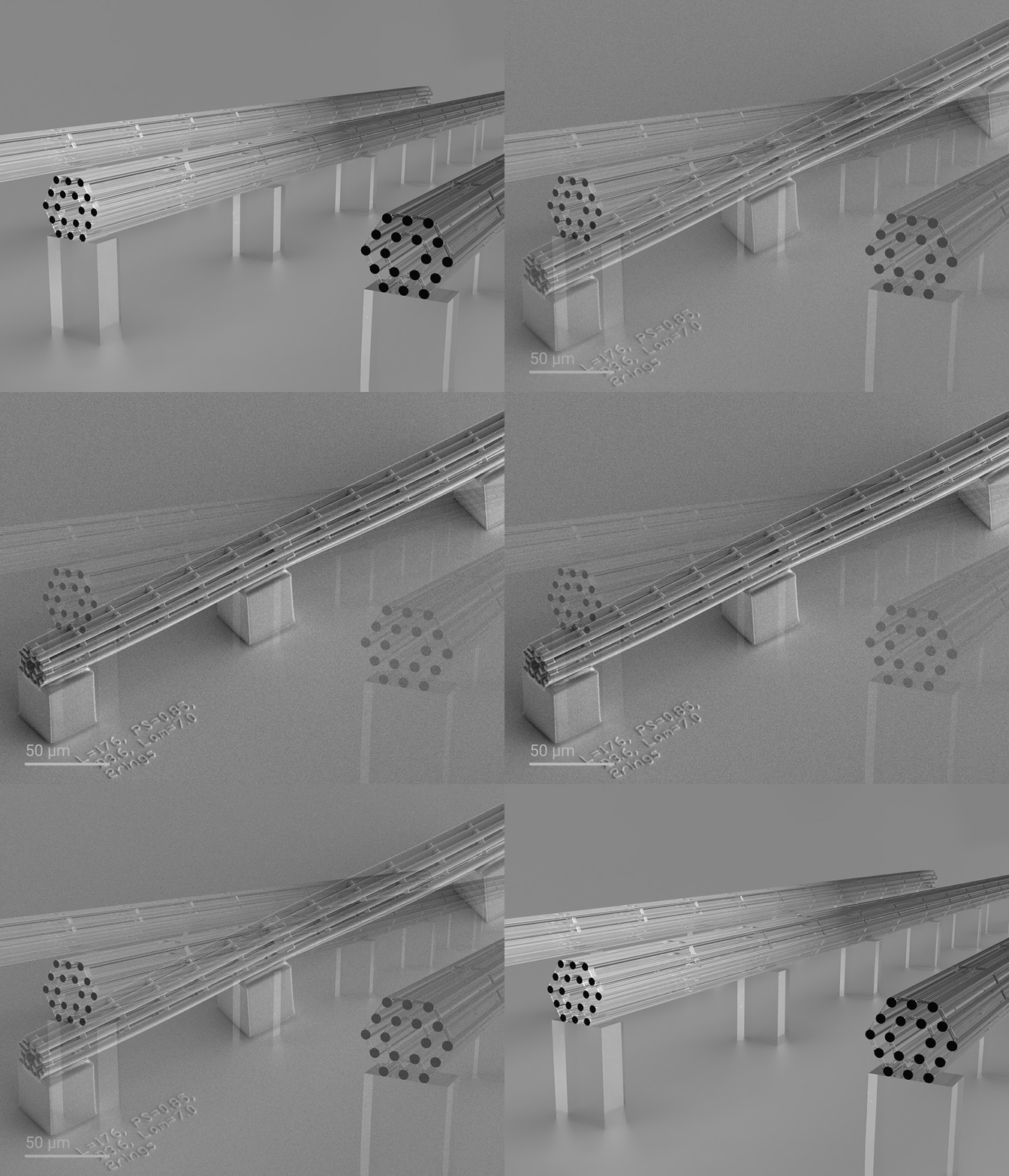
High-resolution 3D printing enables hollow-core 3D photonic crystal waveguides that cannot be realized using conventional planar fabrication methods. Printed directly onto a silicon photonic chip, these 3D structures guide light through an air-filled core surrounded by precisely arranged microstructures, enabling light transmission over centimeter-scale distances. Their open geometry promotes strong interactions between light and surrounding media, such as liquids or gases. By combining optical routing with strong light-matter interaction, hollow-core waveguides open new possibilities for sensing, quantum technologies, and integrated photonic systems.
Read the Customer Success Story here:
On-chip 3D printing of hollow-core photonic waveguides
How robust are 3D-printed free-space micro-optics?
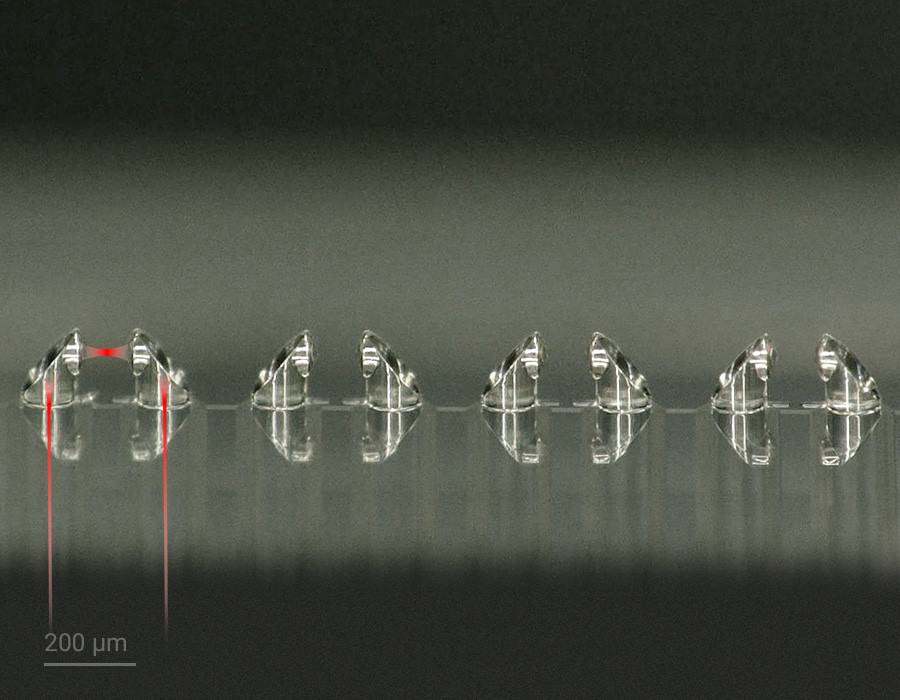
3D-printed free-space micro-optics maintain their optical performance and mechanical integrity under demanding environmental conditions. Free-space optical coupling elements such as periscopic lenses and collimating lenses 3D-printed onto a SMF28 fiber array were tested under damp heat conditions (85 °C / 85 % RH for 1,000 h).
Coupling performance was assessed using the periscopes, where light was transmitted from one fiber through two periscopes on adjacent fibers and coupled back into the second fiber. The coupling loss was measured before and after damp heat exposure and showed excess loss ≤ 0.3 dB per coupling interface. The emission beam was characterized on the 3D-printed collimating lens by using a beam profiler, and the Gaussian beam fit at the beam waist was compared. The mode field diameter (MFD) changed by only 1.3% on average after testing.
In addition, micro-optical elements passed temperature cycling tests from –20 °C to +125 °C over hundreds of cycles. These tests evaluate the material and structural stability of the printed micro-optics. Neither optical performance nor mechanical integrity, including shape stability and adhesion to the substrate, showed any significant change. These results confirm their suitability for demanding applications that require long-term environmental stability and reliable optical performance.
Get your project started with our products

Quantum X align
Aligned 3D printing for integrated photonics & optics

Optics manufacturing materials
Resins optimized for fabrication of microoptical elements

Turnkey process-line solution
Your guided path to industrial-scale microfabrication
Discover the potential of 3D-printed optical couplers
Get inspired by these scientific highlight publications, showcasing optical couplers created with Nanoscribe’s high-resolution 3D printing technology. For even more insights, explore over 2,500 peer-reviewed scientific publications in our premium resources section – simply log in or register for free.
Advancing Vcsel Integration with Femtosecond Laser Microstructuring and 3d Nanoprinting

Athanasios Kyriazis, Salah Guessoum, Jeroen Missinne, Martin Virte, Jürgen Van Erps, Geert Van Steenberg
Ghent University, imec, Vrije Universiteit Brussel and Flanders Make
Optics and Laser Technology, Volume 192, Part A (2025)
Ultrabroadband plug-and-play photonic tensor core packaging with sub-dB loss
Erik Jung, Helge Gehring, Frank Brückerhoff-Plückelmann, Linus Krämer, Clara Vazquez-Martel, Eva Blasco, and Wolfram Pernice
Uni Heidelberg
Science Advances 11, eadz1883(2025)
Highly-efficient fiber to Si-waveguide free-form coupler for foundry-scale...
Luigi Ranno, Jia Xu Brian Sia, Cosmin Popescu, Drew Weninger, Samuel Serna, Shaoliang Yu, Lionel C. Kimerling, Anuradha Agarwal, Tian Gu, Juejun Hu
Massachusetts Institute of Technology, Nanyang Technological University, Bridgewater State University
Photonics Research 12, 1055-1066 (2024)
Photonic Chiplet Interconnection via 3D-Nanoprinted Interposer
Huiyu Huang, Zhitian Shi, Giuseppe Talli, Maxim Kuschnerov, Richard Penty, Qixiang Cheng
Centre for Photonic Systems, Electrical Engineering Division, Department of Engineering, University of Cambridge, Huawei Technologies GmbH
Light: Advanced Manufacturing 5, 46 (2024)